Public Transport in Italian Cities: Metro, Buses, Trams & Apps
Getting Around Italian Cities Without Taxis
Taxis in Italian cities are expensive and unnecessary for 90% of journeys. The public transport networks in Rome and Milan work. They're not perfect — they're old, they run late sometimes, the apps are clunky — but they get you where you're going for €1.50-2 instead of €15-25.
Here's what you need to know.
Rome: The Metro
Rome's metro has two lines. Two. A city of 4 million people, 2,800 years of history, and two metro lines. This is not an accident — every time they dig to build a third line, they find ancient ruins and have to stop.
Line A (orange): Runs from northwest to southeast. Hits: Ottaviano (Vatican), Spagna (Spanish Steps), Barberini, Repubblica, Termini (central hub), Anagnina.
Line B (blue): Runs north to south. Hits: Termini, Colosseo (Colosseum), Laurentina.
Line C (green): New, still expanding. Currently doesn't reach the historic center. Skip it for now.
Ticket prices:
- Single ride: €1.50 (valid 100 minutes on buses, 1 metro ride)
- 24-hour pass: €7
- 48-hour pass: €12.50
- 72-hour pass: €18
- Weekly pass: €24
Buy tickets: At metro stations (machines accept card), tabacchi (tobacco shops), newsstands. Contactless card works at some gates. Not reliable enough to depend on — buy tickets before.
The problem with Rome's metro: Most things worth seeing are NOT on the metro. The Pantheon, Trastevere, Campo de' Fiori, Borghese Gallery, Testaccio — all buses or walking. The metro gets you to the Vatican and Colosseum. Walking and buses do the rest.
Rome: Buses
Rome's bus network covers everything the metro misses. But Rome traffic is chaotic, so buses run late.
Useful lines:
- 40 / 64: Vatican to Termini (tourist central, crowded)
- 23: Along the Tiber, good for Trastevere
- 116: Electric minibus, historic center, narrow streets
- H: Main spine, north-south through center
Same ticket as metro (€1.50, valid 100 minutes).
Validate on the bus — there are orange/yellow machines as you board. Inspectors do check. Fine: €100.
Milan: The Metro
Milan's metro is what Rome's should be. 5 lines, modern stations, air conditioning, frequent service.
Lines:
- M1 (red): East-west spine. Hits: Sesto, Loreto, Centrale FS, Lima, Loreto, Pagano, De Angeli
- M2 (green): Crosses M1. Hits: Centrale FS, Garibaldi, Cadorna (Castello), Romolo
- M3 (yellow): North-south. Hits: Centrale FS, Duomo (cathedral), Missori, Brenta
- M4 (blue): Newest line. Airport express to Linate. Also serves center.
- M5 (lilac): Northwest connector. Hits: Garibaldi, Monumentale, Bignami
Key fact: Duomo station (M1+M3) is the city center. Everything radiates from there.
Ticket prices:
- Single ride: €2.20 (valid 90 minutes, unlimited transfers)
- 24-hour pass: €7.60
- 3-day pass: €12
- 10-trip carnet: €19.50
Milan transport app: ATM Milano — official app. Shows real-time departures, plan routes, buy tickets in-app (QR code on your phone).
Florence: Mostly Walking
Florence's historic center is small. 80% of what you're there to see is walkable from each other.
ATAF buses exist and cover the city, but for the center you won't need them much.
Ticket: €1.70 per ride, 90 minutes validity.
Useful line:
- 7: San Marco area to Fiesole (hilltop views)
- 13: Piazzale Michelangelo (panoramic view point, sunset spot)
Electric minibuses C1, C2, C3, C4: Run through the tiny streets of the historic center where regular buses can't fit. Good for getting between neighborhoods fast.
Venice: Vaporettos (Water Buses)
Venice has no cars. No taxis. No metro. No buses. It has vaporettos — water buses that run on the canals.
Main line: Line 1. Goes the full length of the Grand Canal. Slow (makes every stop), but the most scenic journey in Italy. Costs €9.50 for a single ride.
Line 2: Faster, fewer stops on the Grand Canal.
Passes:
- 24-hour: €25
- 48-hour: €35
- 72-hour: €45
- 7-day: €65
Honest advice: If you're in Venice for 2+ days, get the 48-hour pass. Single rides at €9.50 add up fast.
Water taxis (Motoscafi): Private boat taxis. From airport to city center: €80-120. Romantic, unnecessary, expensive.
Apps for Italian Public Transport
- Moovit: Works in all Italian cities. Real-time departures, route planning, covers all transport types.
- Google Maps: Transit mode works for most city routes. Use as backup.
- ATM Milano: Essential for Milan specifically. Official, reliable.
- Roma Mobilità: Rome's official app. Less reliable than Moovit.
- Actv Venice: Official Venice transport app. Good for vaporetto schedules.
Walk More Than You Think
The honest advice: walk more. Italian cities are built for walking. The streets between metro stops are often more interesting than the stops themselves. In Rome especially — getting lost in the backstreets near Campo de' Fiori or Trastevere is the experience, not a problem.
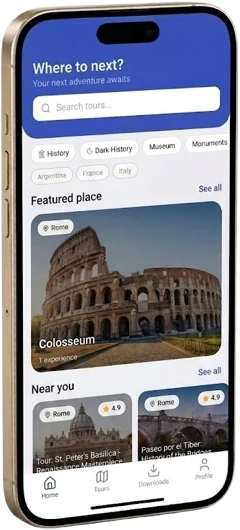
Trevurs tours are designed for walking. Download the app, pick a neighborhood audio tour, put in your earphones, and walk. The transport gets you to the neighborhood. Trevurs shows you what's there.