Learn Italian for Travel: Essential Phrases, Pronunciation & Food Vocabulary
You Don't Need to Speak Italian. But You Should Try.
Every Italian person you meet speaks better English than you speak Italian. This is a fact. Nobody expects you to be fluent.
But when you walk into a bar in Florence and say "buongiorno" instead of "hi," something changes. The barista smiles differently. You get the real price, not the tourist price. The experience shifts.
10 phrases. That's all it takes.
Pronunciation: The Rules That Actually Matter
Italian is phonetic. Once you know these rules, you can read anything:
- "c" before e/i = "ch" sound: Ciao = "chow", Venezia = "veh-NET-see-ah"
- "c" before a/o/u = hard "k": Como = "KOH-moh"
- "ch" = always hard "k": Chianti = "kee-AN-tee"
- "g" before e/i = "j" sound: Gelato = "jeh-LAH-toh", Giro = "JEE-roh"
- "gh" = hard "g": Spaghetti = "spah-GET-tee"
- "gli" = "lyee" sound: Famiglia = "fah-MEE-lyah"
- "gn" = "ny" sound: Gnocchi = "NYOH-kee"
- Every vowel is pronounced: Bruschetta = "broos-KET-tah" (not "broo-SHET-tah")
Most common mispronunciation tourists make: Bruschetta. The "ch" in Italian is always "k." "Broo-SKET-tah." Italians will correct you, warmly.
Essential Phrases: The 10 That Open Doors
Greetings:
- Buongiorno (bwon-JOR-noh) — Good morning / Good day (use until ~2pm)
- Buonasera (bwon-ah-SEH-rah) — Good evening (use after ~2pm)
- Ciao (chow) — Hello/Goodbye (informal, between friends)
- Arrivederci (ah-ree-veh-DER-chee) — Goodbye (formal)
Politeness:
- Per favore (pehr fah-VOH-reh) — Please
- Grazie (GRAT-see-eh) — Thank you
- Prego (PREH-goh) — You're welcome / Don't mention it / After you
- Mi scusi (mee SKOO-zee) — Excuse me (formal)
- Scusa (SKOO-zah) — Excuse me (informal)
Survival:
- Parla inglese? (PAR-lah een-GLEH-zeh) — Do you speak English?
- Non capisco (non kah-PEE-skoh) — I don't understand
- Dove è...? (DOH-veh eh) — Where is...?
- Quanto costa? (KWAN-toh KOS-tah) — How much does it cost?
- Il conto, per favore (eel KON-toh pehr fah-VOH-reh) — The bill, please
- Aiuto! (ah-YOO-toh) — Help!
At the Bar: Coffee Culture
Italian bar culture is specific. Get it right.
- Walk in, go to the cashier, pay first, get a receipt (scontrino)
- Take the receipt to the barista, say your order
- Stand at the bar. Always.
- Sitting at a table costs 2-3x more
What to order:
- Un caffè — a standard espresso (just say "caffè")
- Un cappuccino — only in the morning. Italians don't drink cappuccino after 11am.
- Un caffè macchiato — espresso with a splash of milk
- Un caffè americano — espresso diluted with hot water (closer to filter coffee)
- Un caffè freddo — iced espresso
- Una spremuta — fresh-squeezed orange juice
Never ask for: A "latte" (you'll get a glass of milk). Say "latte macchiato" for the milk drink.
At the Restaurant
The structure of an Italian meal:
- Antipasto — starter (bruschetta, affettati, crostini)
- Primo — first course (pasta, risotto, soup)
- Secondo — second course (meat or fish)
- Contorno — side dish (vegetables, served separately from secondo)
- Dolce — dessert
You don't need to order everything. Order what you want.
Useful phrases:
- Vorrei... (vor-REH-ee) — I would like...
- Posso avere...? (POS-soh ah-VEH-reh) — Can I have...?
- Senza... (SEN-tsah) — Without... (senza glutine = gluten free)
- Sono allergico a... (SOH-noh ah-LEHR-jee-koh ah) — I'm allergic to...
- È buono! (eh BWOH-noh) — It's good!
- Delizioso (deh-leets-YOH-zoh) — Delicious
Food Vocabulary You Actually Need
- Acqua naturale / frizzante — still / sparkling water
- Vino rosso / bianco / rosato — red / white / rosé wine
- Birra alla spina — draft beer
- Il menù del giorno — menu of the day (usually good value)
- Antipasto della casa — house starter (usually a good deal)
- Fatto in casa — homemade
- Locale — local (as in locally sourced)
Directions Basics
- Sinistra (see-NEES-trah) — Left
- Destra (DES-trah) — Right
- Dritto / Sempre dritto — Straight ahead
- Vicino (vee-CHEE-noh) — Near
- Lontano (lon-TAH-noh) — Far
Explore Italy's Language With Trevurs
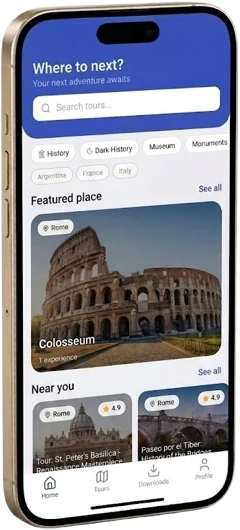
Language and culture are the same thing in Italy. Trevurs audio tours are narrated by locals — you'll hear real Italian rhythm and vocabulary woven into the stories of each neighborhood. It's not a language lesson. It's context that makes the language make sense.