Rome on a Budget: Free Sights, Nasoni and Cheap Eats
Rome has around 2,500 public drinking fountains, and every one of them pours cold, clean water from the same aqueduct network for free, all day. Locals call them nasoni ("big noses") because of their curved iron spouts. They are the perfect symbol of budget Rome: the city charges for a few headline sights, but a huge part of what makes it unforgettable still costs nothing.
That said, 2026 brought new fees you should know about. Here is what is still free, what changed, and how to eat and move around without burning your budget.
What Changed in 2026
- Trevi Fountain: since February 2, 2026, entering the area right next to the basin costs €2, every day from 9:00 to 22:00, payable by card at the entrance or online. Residents and children under five are exempt. You can still see the fountain for free from the edge of the piazza, and early morning or late at night there is no ticket at all.
- Pantheon: the ticket went from €5 to €7 on July 1, 2026. Visitors aged 18 to 25 still pay €2, under-18s get in free, and Rome residents too. It is free on the first Sunday of the month (expect a line).
Neither fee is a reason to skip them, but they are a reason to plan the timing.
Free Sights That Are Actually Worth It
Churches with masterpieces inside
Rome's churches are free museums. A few you should not miss:
- San Luigi dei Francesi (near Piazza Navona): three Caravaggio paintings on the life of Saint Matthew. Bring a coin, the lights work on a timer.
- Santa Maria del Popolo: two more Caravaggios in the Cerasi Chapel, plus a Raphael-designed chapel.
- San Pietro in Vincoli: Michelangelo's Moses and the chains said to have bound Saint Peter.
- Santa Maria Maggiore: golden 5th-century mosaics and a coffered ceiling gilded, according to tradition, with the first gold brought from the Americas.
- St. Peter's Basilica: entry is free (the dome climb is paid). Go before 8:00 to beat the security line.
Dress code applies in all of them: shoulders and knees covered.
The Bocca della Verità
The "Mouth of Truth" sits in the portico of Santa Maria in Cosmedin. Legend says it bites the hand of liars. There is no formal ticket, but a small donation is requested and the line can stretch at midday. Go early, take your photo, then step inside the church, which is free and far older than the selfie spot outside.
The Aventine Hill and the famous keyhole
Climb to the Piazza dei Cavalieri di Malta and look through the keyhole of the green door of the Knights of Malta priory. You will see St. Peter's dome perfectly framed at the end of a garden avenue. It is free, but there is often a queue of a few minutes. Two steps away, the Giardino degli Aranci (Orange Garden) has one of the best free sunset views over the Tiber, and yes, a nasone to refill your bottle.
The Gianicolo
The Janiculum Hill, above Trastevere, has the widest free panorama of the city. Every day at noon a cannon fires from below the terrace, a tradition dating back to 1847 to synchronize the city's church bells. Walk up from Trastevere along Via Garibaldi and stop at the Fontanone (Fontana dell'Acqua Paola) on the way.
The classic free walk
Piazza Navona, the Spanish Steps, Campo de' Fiori, the Jewish Ghetto, Trastevere's lanes and the view of the Forum from the Campidoglio terraces (behind the Capitoline Museums) cost zero. You can easily spend a whole day on them.
Free Museum Days
- First Sunday of the month: state museums and sites are free (the Domenica al museo program). That includes the Colosseum archaeological park, Castel Sant'Angelo, the Baths of Diocletian and Galleria Borghese (reservation still required). The Colosseum on these days usually requires booking a free slot online in advance; check the official site the week before.
- Last Sunday of the month: the Vatican Museums and the Sistine Chapel are free from about 9:00 to 14:00 (last entry around 12:30), except when it coincides with major holidays. The line starts long before opening, so arrive by 7:30 or accept a long wait.
On any day, under-18s enter state museums for free, and EU citizens aged 18 to 25 usually pay a reduced €2.
Nasoni: Your Free Water Bottle Station
Bring a reusable bottle. Nasoni have been running since 1874 and the water is the same as at home taps. The trick locals use: block the spout with your finger and the water shoots up from a small hole on top, like a drinking fountain. The Acea Waidy Wow app maps them all.
Getting Around for Less
The historic center is compact, and walking is the cheapest and often fastest option. For longer distances (Vatican, Termini, Appian Way):
- BIT ticket: €1.50, valid 100 minutes on buses and trams, plus one metro ride. There has been talk of raising it to €2, so check the price at the machine.
- Passes: 24 hours €8.50, 48 hours €15, 72 hours €22, 7 days €29.
- Tap & Go: you can tap a contactless card or phone directly at metro gates and on buses. Use the same card each time and each ride is charged at the BIT fare; several guides report a daily cap equal to the 24-hour pass, so verify on ATAC before relying on it.
Do the math: if you walk most of the day, two or three single rides are cheaper than a pass. Always validate paper tickets, inspectors fine on the spot.
Eating Well on a Budget
- Pizza al taglio: rectangular pizza sold by weight. A generous slice costs around €2 to €5. Try Pizzarium near the Cipro metro stop or any forno in your neighborhood. Forno Campo de' Fiori sells a superb plain pizza bianca.
- Supplì: fried rice balls with tomato and a mozzarella heart, usually €2 to €3 each. Two make a snack, four make lunch.
- Trapizzino: a pizza-dough pocket stuffed with Roman stews, around €5.
- Coffee at the bar: an espresso drunk standing up costs around €1.20 to €1.50. Sitting at a table in a tourist square can triple that.
- Aperitivo: from about 18:00, many bars serve a spritz or glass of wine (roughly €7 to €10) with snacks. In Rome the free food is usually lighter than in Milan, but in some Pigneto or San Lorenzo bars it can stand in for dinner.
- Trattorias: eat lunch rather than dinner, avoid menus with photos and touts at the door, and expect a coperto (cover charge) of €1.50 to €3 per person.
The Tourist Tax: Budget For It
Rome charges a contributo di soggiorno per person, per night, for the first 10 consecutive nights. Current rates run from about €4 (1 to 2 star hotels) to €10 (5 star), with B&Bs and short-term rentals at around €6. Children under 10 are exempt. It is usually paid at check-out and not included in booking site prices. There has been talk of an increase, so look at the latest Roma Capitale table before you go.
For a couple staying four nights in a 3-star hotel, that is around €48 extra.
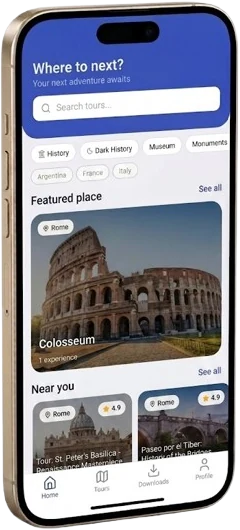
Explore Rome with Trevurs
The best things in Rome were never behind a ticket desk, they are in the stories. Trevurs has free self-guided audio tours that work offline: "Imperial Rome: From the Colosseum to the Vatican", "The Palatine: The Hill Where Rome Was Born", "The Colosseum: 2,000 Years of History", "Rome: Nero, the Emperor Who Burned in Memory", "The Vatican: How the Church Built the Smallest and Most Powerful State on Earth" and "Rome: the Catacombs, Where Early Christians Did Not Hide but Buried Their Dead". Download them, refill your bottle at the nearest nasone and walk the city at your own pace without paying a guide.