3 Days in Rome: The First-Timer Itinerary by Neighborhood
Since February 2026, getting close to the Trevi Fountain costs €2. The piazza is still free, but the steps down to the basin now have a ticket, a turnstile logic and a cap of about 400 people at a time. It is a small fee, and it says a lot about Rome in 2026: almost every famous spot now asks you to book, pay or show ID. Turn up without a plan and you lose half a day in queues. Turn up with one and three days are enough to see the three Romes that matter for a first visit: the ancient city, the Vatican, and the baroque center that ties them together.
This itinerary groups each day by neighborhood, so you walk instead of crisscrossing the city by bus. Prices and rules below were checked for 2026, but they change often, so confirm on the official sites before you go.
Before you land: what to book
- Colosseum (ticketing.colosseo.it): tickets are nominative, so the name must match your passport or ID. The standard 24-hour ticket is about €18 and covers the Colosseum plus the Roman Forum and Palatine. The Full Experience (arena floor and underground) runs around €24 and is valid for two days. Add a booking fee of roughly €2. Slots open about 30 days ahead and the good ones go fast.
- Vatican Museums (official site only): €20 at the door or €25 online with the booking fee. Book online, ideally a month or more ahead in high season, and avoid resellers. The museums close on most Sundays, except the last Sunday of the month, when entry is free and the line is brutal.
- Pantheon: the ticket went from €5 to €7 on July 1, 2026. Book a time slot on museiitaliani.it; walk-ins are limited.
- Trevi Fountain: €2 to enter the basin area, roughly 9 a.m. to 10 p.m. Card only at the entrance, or buy online.
Day 1: Ancient Rome (Colosseum, Forum, Palatine, Monti)
Morning: the Colosseum. Take the first slot of the day (around 8:30 a.m.) and you share the arena with far fewer people. Metro B to Colosseo drops you at the door. Give it 90 minutes, two hours if you booked the underground, where gladiators and animals waited for the lifts that hauled them into the light.
Late morning: the Palatine. Your ticket also opens the hill where, according to the legend, Romulus founded the city in 753 BC, and where emperors later built palaces so large that the word "palace" itself comes from Palatium. Head up for the terrace over the Circus Maximus, then look down on the Forum from the Farnese Gardens.
Early afternoon: the Roman Forum. Walk the Via Sacra past the Arch of Septimius Severus, the Temple of Saturn and the spot where Julius Caesar was cremated. There is little shade, so bring water; the city's nasoni fountains are free and drinkable.
Late afternoon: Capitoline Hill. Climb Michelangelo's Cordonata to the Piazza del Campidoglio. Walk behind the Palazzo Senatorio for the free terrace with the best overview of the Forum you just crossed. If you still have energy, the Capitoline Museums (around €15 to €16) hold the original bronze Marcus Aurelius and the she-wolf.
Evening: Monti. Five minutes from the Forum, Rome's oldest rione is the most relaxed place to eat on this side of town: ivy on the walls, wine bars around Piazza della Madonna dei Monti, and trattorias that still serve carbonara and cacio e pepe at fair prices.
Day 2: The Vatican, Prati and Trastevere
Morning: Vatican Museums and Sistine Chapel. Take the earliest entry you can get. The full route is about 7 km of corridors, so do not try to see everything: Raphael Rooms, the Gallery of Maps, the Laocoön in the Octagonal Courtyard, then the Sistine Chapel. No photos inside the chapel, and the guards do enforce it. Plan three hours.
Midday: St. Peter's Basilica. Entry is free, but there is a security line in the colonnade. Shoulders and knees must be covered, which applies to everyone. Climbing the dome costs extra (roughly €15 to €20 with the lift partway) and gives you the view over the square that Bernini designed as two arms embracing the faithful.
Lunch: Prati. The streets east of the Vatican are calmer and cheaper than Borgo, right by the walls. Look for a tavola calda or a sandwich at a deli rather than the menus with photos.
Afternoon: Castel Sant'Angelo. Built as Hadrian's tomb, turned into a fortress and a papal refuge (a covered corridor, the Passetto, links it to the Vatican). Even if you skip the inside, cross the Ponte Sant'Angelo with Bernini's angels.
Evening: Gianicolo and Trastevere. Walk up the Gianicolo at sunset for the classic panorama over Rome's domes, then come down into Trastevere for dinner. Away from Piazza di Santa Maria, the side streets toward Viale di Trastevere are where Romans actually eat.
Day 3: The baroque center (Pantheon, Navona, Trevi, Spanish Steps)
Early morning: Trevi Fountain. Go before 8 a.m. if you want the fountain nearly to yourself and free; the €2 rule kicks in around 9. Throw a coin with your right hand over your left shoulder. The coins, more than a million euros a year by most estimates, go to the charity Caritas.
Morning: the Pantheon. Nearly 1,900 years old and still the largest unreinforced concrete dome in the world. The 9-meter oculus is open to the sky, and the floor has small drain holes for the rain. Raphael is buried here. With a booked slot, 30 to 45 minutes is enough.
Late morning: Piazza Navona and Campo de' Fiori. Navona keeps the exact shape of Domitian's stadium, and Bernini's Fountain of the Four Rivers sits in the middle. Two minutes away, Campo de' Fiori has its morning market under the hooded statue of Giordano Bruno, burned on that spot in 1600.
Lunch: around the Pantheon prices double. Walk toward the Jewish Ghetto for carciofi alla giudia (fried artichokes) when in season.
Afternoon: Spanish Steps and Villa Borghese. Climb the 135 steps (sitting on them can earn you a fine), then walk to the Pincio terrace for the view over Piazza del Popolo. If you booked well ahead, the Galleria Borghese has Bernini's marble sculptures; it requires reservations and timed slots.
If you have half a day more
- Appian Way and the catacombs: bus 118 or a bike gets you onto the old consular road. The catacombs of San Callisto or San Sebastiano are visited with guides; tickets are around €10 to €12.
- Ostia Antica: 30 minutes by train, a whole Roman port town with far fewer crowds than the Forum.
What to skip or change
- Do not buy "skip the line" tickets from people on the street near the Colosseum or the Vatican.
- Do not try the Vatican and the Colosseum on the same day. You will hate both.
- Do carry ID every day: Colosseum and Vatican tickets are checked against it.
- Do validate bus and metro tickets, or tap your contactless card at the gates. A single ride is €1.50 and lasts 100 minutes.
Explore Rome with Trevurs
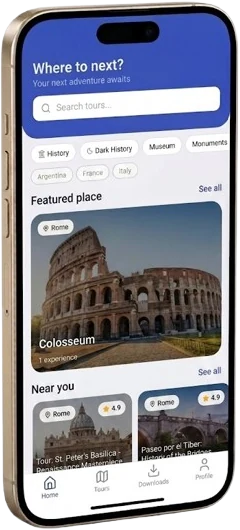
Each day of this itinerary has a free, self-guided audio tour in the Trevurs app, and they all work offline. On day 1, play "The Colosseum: 2,000 Years of History" and then "The Palatine: The Hill Where Rome Was Born" as you walk the ruins. "Imperial Rome: From the Colosseum to the Vatican" links days 1 and 2 on foot, and "The Vatican: How the Church Built the Smallest and Most Powerful State on Earth" gives you the story before you step into the museums. With extra time, "Rome: Nero, the Emperor Who Burned in Memory" and "Rome: the Catacombs, Where Early Christians Did Not Hide but Buried Their Dead" take you beyond the classic route. Download them before you go and keep your data for the maps.