Milan History: From Roman Mediolanum to Modern Metropolis
Milan's History: The City That Was Always Reinventing Itself
Milan doesn't look like a history city. No ancient ruins dominating the skyline, no medieval walls intact everywhere, no preserved old quarters like Rome or Florence.
That's because Milan has been destroyed and rebuilt multiple times. And each time, it rebuilt itself as something new. That's the history.
Roman Mediolanum (3rd century BC – 5th century AD)
Milan was founded by Celtic tribes around 400 BC. The Romans conquered it in 222 BC and named it Mediolanum — meaning "in the middle of the plain."
Why it mattered: By the 3rd century AD, Mediolanum was the de facto capital of the Western Roman Empire — more important than Rome, which had become too difficult to defend.
Emperor Diocletian ruled from here. Constantine issued the Edict of Milan here in 313 AD — legalizing Christianity throughout the empire.
What's left to see:
- Roman columns (Colonne di San Lorenzo) — 16 Roman columns still standing, 4th century, free to see, Corso di Porta Ticinese area
- Museo Archeologico di Milano — Roman artifacts, mosaics, sculptures (Via Magenta 15, €5)
Visconti Dynasty (1277–1447) — The Duomo Begins
The Visconti family ruled Milan for nearly 200 years and turned it into a major European power.
Key fact: The Duomo was started in 1386 by Gian Galeazzo Visconti. He wanted the largest Gothic cathedral in the world. He died in 1402 before it was finished. It wasn't completed for another 500 years (Napoleon finally forced completion in 1809).
What the Visconti built:
- The Duomo (started 1386)
- Castello Visconteo in Pavia
- Extensive canal system for trade
What's left to see:
- The Duomo — exterior mainly Gothic, massive, overwhelming (€5 interior, €13 roof)
- Visconti archives in the Ambrosiana Library
Sforza Dynasty (1450–1499) — Leonardo da Vinci
The Sforza family took over from the Visconti and hired the best artists and architects in Italy.
Key fact: Leonardo da Vinci worked in Milan for 17 years (1482–1499) under Ludovico Sforza. He worked as an engineer, military architect, and painter.
What Leonardo did in Milan:
- Painted The Last Supper (1495–1498) — now in Santa Maria delle Grazie
- Designed canals, hydraulic systems, and military machines
- Wrote notebooks (Codex Atlanticus) now in the Ambrosiana
Castello Sforzesco: Built by the Sforza family, expanded and fortified. Bramante and Leonardo both worked on it.
- Address: Piazza Castello
- Entry: €5 (includes museums inside — medieval art, Egyptian collection, Michelangelo's last sculpture)
- Michelangelo's Rondanini Pietà is here — his final, unfinished work, extraordinary
The Last Supper (Il Cenacolo):
- Address: Piazza Santa Maria delle Grazie 2
- Entry: €15 + €2 booking fee (mandatory reservation, book weeks in advance)
- Visit time: 15 minutes only (strictly enforced)
- Tip: Book the moment your dates are confirmed. This sells out months ahead.
Spanish Domination (1535–1706) — Baroque Milan
Spain controlled Milan for 170 years. The city stagnated economically but accumulated enormous religious art.
What was built: Baroque churches everywhere. San Lorenzo, Sant'Ambrogio (originally Romanesque, redecorated), San Alessandro.
Sant'Ambrogio Basilica:
- Founded by Saint Ambrose in 379 AD — one of the oldest churches in Milan
- Current form: 11th–12th century Romanesque
- Entry: Free
- Address: Piazza Sant'Ambrogio 15
Napoleonic Era (1796–1815) — Milan Modernizes
Napoleon conquered Milan in 1796. He finished the Duomo (forced the last stones placed). He also built the Arco della Pace, redesigned the city center, built the Foro Bonaparte.
The Arena Civica: Still used today for athletics events.
Arco della Pace: Triumphal arch at the end of Corso Sempione — built for Napoleon, completed after his fall.
Industrial Revolution & Risorgimento (1815–1861)
Milan was the heart of Italy's independence movement. The Five Days of Milan (Cinque Giornate, March 1848) — Milanese citizens expelled the Austrian garrison from the city. Monument: Monumento alle Cinque Giornate (Piazza Cinque Giornate, free).
The canal system (Navigli) made Milan the industrial center of a unified Italy after 1861.
World War II — Bombing and Resistance
Milan was heavily bombed by Allied forces in 1943. Large parts of the historic center were destroyed — which is why Milan looks modern compared to other Italian cities.
Mussolini was captured and executed near Lake Como in April 1945. His body was hung in Piazzale Loreto in Milan — a square you can still visit (nothing marks it, but it's near Loreto metro station).
Reconstruction and the Economic Miracle (1950s–1960s)
Milan rebuilt fast and became Italy's economic engine. The Torre Velasca (1958) — a skyscraper that looks medieval — was built in this era. Pirelli Tower (1958) was Italy's tallest building.
This is when Milan's design industry emerged: La Rinascente department store, early Prada, Armani, the furniture companies that still define Italian design.
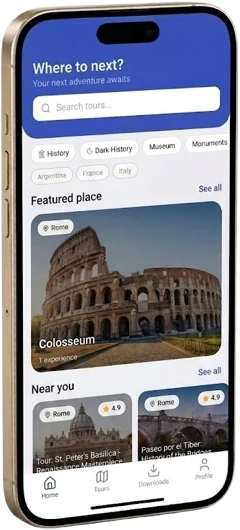
Explore Milan's History with Trevurs
Download Trevurs and walk the historical layers of Milan with audio guides. From Roman columns to the Sforza castle to the bombed and rebuilt post-war streets — the city's history is in the streets, not just in museums. Trevurs gives you the context as you walk.