Toledo Day Trip: The City of Three Cultures in One Day
In Toledo, a mosque with a stone inscription dated 999, a synagogue built around 1180 and a cathedral whose first stone was laid in 1226 all stand within a ten minute walk of each other. That cathedral turns 800 in 2026, and the whole old town, a granite hill wrapped on three sides by the Tagus River, has been a UNESCO World Heritage Site since 1986. It sits 33 minutes from Madrid by high-speed train, which makes it the easiest big day trip in Spain and also the easiest one to do badly.
This guide is only about Toledo: how to get there, how to get up the hill without wrecking your legs, which tickets are worth it and the route that fits Christians, Jews and Muslims into one day.
Getting There from Madrid
Train (fastest). Renfe Avant trains leave from Madrid Puerta de Atocha-Almudena Grandes and reach Toledo in about 33 minutes. Expect around 14 € each way for a standard ticket (prices move with demand, so check Renfe before you go). There are roughly a dozen or more departures per day, and seats are assigned, so book the morning outbound and the evening return at least a few days ahead on weekends. Toledo's station is worth a look in itself: a Neo-Mudéjar building from 1919 with tiled walls and a clock tower.
Bus (cheapest). Alsa runs buses from the Plaza Elíptica interchange (Metro lines 6 and 11) about every 30 minutes. The direct service takes about an hour and one-way fares usually start around 6 €. The bus station in Toledo is closer to the old town than the train station.
From the train station, city buses L5, L61 and L62 go up to Plaza de Zocodover for around 1.40 €. A taxi costs a few euros more. Walking takes 20 to 25 minutes, mostly uphill.
The Escalator Trick
Toledo's old town sits about 100 meters above the river and the streets were laid out for mules, not tourists. The fix is the Recaredo escalators (Escaleras Mecánicas de Recaredo), a chain of six free escalators cut into the hillside next to the Puerta de Bisagra and the parking lot of the same name. They climb roughly 36 meters, straight to the upper town near Santiago del Arrabal and the Paseo del Miradero, and they usually run from early morning until around 10 p.m. If you arrive by bus or car, start here. Save the walk down for the end of the day, when it is downhill.
The Pulsera Turística: Is It Worth It?
The Pulsera Turística is a wristband that gets you into seven monuments for about 14 € (it used to be 12 €, so confirm at the ticket desk). It includes:
- Mezquita del Cristo de la Luz
- Sinagoga de Santa María la Blanca
- Santo Tomé (home of El Greco's Burial of the Count of Orgaz)
- Monasterio de San Juan de los Reyes
- Iglesia de los Jesuitas (San Ildefonso), with tower views
- Real Colegio de Doncellas Nobles
- Iglesia del Salvador
Single tickets for the main ones cost about 4 € each, so the wristband pays for itself at four monuments. It allows one entry per monument and you can buy it at any of the seven ticket desks or online. It does not include the Cathedral, the Alcázar, the Sinagoga del Tránsito or the El Greco Museum. Monuments generally open 10:00 to 18:45 from March to mid-October and close an hour earlier in winter.
The Three Cultures Route
Catedral Primada. Start early, because this is the big one. Gothic, begun in 1226 and finished in 1493, it holds El Greco's El Expolio in the sacristy, a choir carved by Rodrigo Alemán and Alonso Berruguete, and the Transparente, a Baroque explosion of marble and light where a hole was cut in the vault so the sun could fall on the altar. General admission is around 12 €, with the tower included when it is open. Allow at least 90 minutes.
Mezquita del Cristo de la Luz. A small brick cube with nine domes, each one different, built in 999 when Toledo was part of the Caliphate of Córdoba. The Arabic inscription on its facade still gives the date. Christians later added an apse and turned it into a church, so you can read both stories in the same walls.
Sinagoga de Santa María la Blanca. The surprise of the day: a forest of white horseshoe arches and pine-cone capitals that looks like a mosque, was built as a synagogue and has been a church since the early 15th century. It is the best summary of Toledo you will find in one room.
Sinagoga del Tránsito and the Sephardic Museum. Built in 1357 by Samuel ha-Leví, treasurer to King Pedro I, it has some of the finest Mudéjar plasterwork in Spain, with Hebrew inscriptions running around the walls. It is a state museum, so admission is only about 3 € and it is free on Saturday afternoons and Sundays. Closed Mondays.
Santo Tomé and the Burial of the Count of Orgaz. El Greco painted it between 1586 and 1588 for this church, and it has never left. The lower half is a funeral; the upper half is heaven opening up. Look for the boy in the lower left corner: he is El Greco's son, and the handkerchief in his pocket carries the year of his birth.
San Juan de los Reyes. Built by the Catholic Monarchs to celebrate a battle win, with one of the most beautiful cloisters in the country. The chains hanging on the outside walls belonged to Christian captives freed from Granada.
The Alcázar. The square fortress that dominates the skyline now holds the Army Museum (Museo del Ejército). Tickets are about 5 €, it is closed on Mondays, and recent sources list Wednesday as a free day (check at the desk). The building is famous for the 1936 siege of the Spanish Civil War. Even if you skip the museum, the café at the top has one of the best terrace views in town.
A Realistic One-Day Plan
- 9:00 to 10:00: Train from Atocha, bus up to Zocodover.
- 10:00 to 11:45: Cathedral.
- 12:00 to 13:00: Santo Tomé, then down into the old Jewish quarter.
- 13:00 to 14:30: Lunch. Try carcamusas (pork stew in tomato sauce) or anything with partridge, the local game classic.
- 14:30 to 16:30: Tránsito, Santa María la Blanca and San Juan de los Reyes.
- 16:30 to 17:30: Cristo de la Luz and the climb to Puerta de Bisagra.
- Sunset: Mirador del Valle, then the evening train back.
If you want to skip something, skip the Alcázar museum unless you love military history. Don't skip the synagogues.
Mazapán and the Mirador del Valle
Toledo's sweet is mazapán, almond and sugar, traditionally made by nuns since at least the 16th century. The most famous shop is Santo Tomé, on the street of the same name, making it since 1856. Several convents still sell their own through a revolving window: you put your coins in, a box of sweets comes back, and you never see the nun.
End the day at the Mirador del Valle, on the far side of the Tagus. This is the postcard view: the whole city stacked on its hill, the cathedral spire and the Alcázar side by side, the river curling around below. It is about a 30 to 40 minute walk from the Puente de Alcántara along the ring road, a short taxi ride, or a stop on the little tourist train that leaves from Zocodover. Go at golden hour.
Explore Toledo with Trevurs
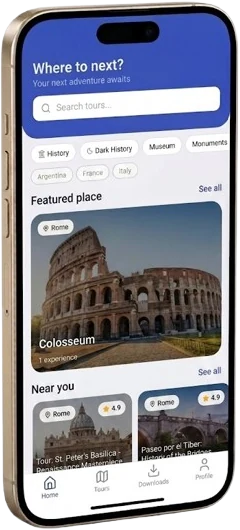
If you want the stories behind every stone without hiring a guide, download Trevurs and take Toledo: Moors, Jews and Christians in One Square Kilometer. It is a free, self-guided audio tour that walks you through the cathedral quarter, the Jewish quarter and the Muslim city in the right order, and it works offline, so you won't need signal in those narrow streets.