Pope Leo XIV in Uruguay: Montevideo, Florida and What to See While You're There
Trip status (updated October 17, 2026): Pope Leo XIV had surgery at Rome's Gemelli hospital on October 13 to remove the lower lobe of his right lung after a nodule was diagnosed as adenocarcinoma. He was discharged on October 17 and is back at the Vatican. The Holy See has not set a date to confirm or postpone the South America trip, and says it depends on his recovery. The Uruguayan Church is keeping the schedule below for now. Everything in this guide about Montevideo, Florida and Colonia holds true whatever happens to the dates.
Uruguay may be the most secular country in the Americas. It separated church and state in the 1918 constitution, and a 1919 law took the religion out of the calendar: Christmas officially became "Family Day" and Holy Week is still called "Tourism Week" today. That is the country where Pope Leo XIV is scheduled to open his first South American tour, with a prayer vigil inside the Estadio Centenario, the stadium that hosted the very first World Cup final in 1930.
The official program, published by the Holy See on September 21, 2026, puts him in Uruguay from Friday November 6 to Sunday November 8: Montevideo, a day trip to Paysandú, and a final Mass in Florida at the shrine of the country's patron, the Virgin of the Thirty-Three. Here is the day-by-day plan, how to get a free pass, and what to see while you are there.
The Official Schedule in Uruguay
All times are local (Uruguay, UTC-3), as published in the Vatican program.
Friday, November 6: Montevideo
- 4:30 pm: arrival at Carrasco International Airport.
- 5:30 pm: welcome ceremony at Plaza Independencia, followed at 5:45 pm by a meeting with authorities, civil society and the diplomatic corps.
- 6:15 pm: courtesy visit to President Yamandú Orsi at the Edificio José Artigas.
- 7:10 pm: Vespers with clergy, religious and seminarians at the Metropolitan Cathedral, on Plaza Matriz in the Old Town.
Saturday, November 7: Paysandú and Montevideo
- 10:00 am: Mass at Parque París Londres in Paysandú (he flies up in the morning and is back in Montevideo by 1:30 pm).
- 5:00 pm: meeting with the social reality of Casavalle, at the Nuestra Señora de Guadalupe parish.
- 6:00 pm: meeting with the world of education at the Universidad Católica del Uruguay.
- 7:00 pm: prayer vigil at the Estadio Centenario.
Sunday, November 8: Florida
- 10:30 am: Mass in the square in front of the Cathedral Basilica of Florida, National Shrine of the Virgin of the Thirty-Three. It coincides with the national pilgrimage organized by the Uruguayan bishops.
- 3:10 pm: farewell at Carrasco, and at 3:30 pm he flies to Buenos Aires.
Free Passes: How They Work
The three big open events (the Paysandú Mass, the Centenario vigil and the Florida Mass) need a pass. They are free, personal and single-use. The organizers announced that passes go live on Friday, October 23 at 11:00 am on the official site, papaleonuruguay.uy, and through the Red UTS network of payment outlets. If a parish or school gave you a card with a code, you enter it online and get your pass as a PDF by email.
The Church has warned that nothing connected to the visit has an entry fee. If someone asks you to pay or transfer money for a "ticket", it is a scam.
The Centenario: a Vigil Where Football History Began
The Estadio Centenario was built in about a year for the 1930 World Cup and named for the centenary of Uruguay's first constitution. On July 30, 1930, Uruguay beat Argentina 4-2 there in the first World Cup final ever played. FIFA later declared it a Historic Monument of World Football, the only stadium with that title.
It sits in Parque Batlle, about 3 km east of downtown. Its tall Torre de los Homenajes is visible from much of the city, and the stadium houses a football museum that is worth a visit on a normal day. For the vigil, plan on arriving hours early: security lines for papal events are slow, and roads around Parque Batlle will be closed. Local press has estimated around 60,000 people, which is roughly the stadium's capacity.
Florida and the Virgin of the Thirty-Three
Florida is a quiet city of about 35,000 people, roughly 100 km north of Montevideo on Ruta 5 (around 1.5 hours by car on a normal day). It matters far more than its size suggests: on August 25, 1825, the assembly that declared Uruguay's independence met here, and the small wooden image of the Virgin of the Thirty-Three, venerated by the patriots of that era, is the country's patron and lives in the cathedral that faces the main square.
Getting there on November 8:
- Bus: intercity buses to Florida leave from the Tres Cruces terminal in Montevideo. Expect extra services and heavy demand that weekend; buy early and check with the operators.
- Parish groups: many Uruguayan parishes are organizing chartered buses. If you are traveling with a church group, this is the easiest option.
- Car: Ruta 5 will be congested from dawn, with likely closures near the center. Leave very early and expect to walk the last stretch.
Fun detail: next to the Tres Cruces terminal stands the large cross from John Paul II's 1987 Mass in Montevideo. If you catch a bus there, take five minutes to see it.
What to See in Montevideo Around the Visit
Most of the Pope's Friday route is a walkable loop through the center, and it doubles as the best introduction to the city.
- Plaza Independencia: the welcome ceremony happens here, under the equestrian statue of Artigas, with the Artigas mausoleum underneath. On one side rises the Palacio Salvo (1928), once the tallest building in South America.
- Puerta de la Ciudadela: the surviving gate of the colonial walls, leading from the plaza into the Old Town.
- Plaza Matriz and the Cathedral: the Metropolitan Cathedral, where the Vespers take place, faces the Cabildo, where, according to the local organizers, the city will hand the Pope its key on Friday evening.
- Mercado del Puerto: 19th-century British ironwork full of grills. Ideal for lunch before an evening event.
- Teatro Solís: the country's grand opera house, just off Plaza Independencia.
- The Rambla: more than 20 km of waterfront promenade along the Río de la Plata, perfect at sunset.
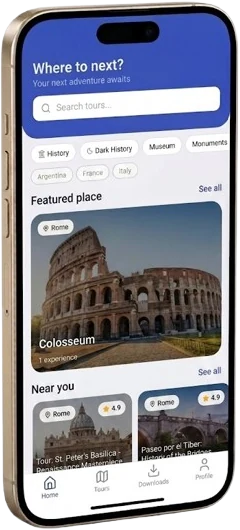
There is a nice irony in that walk. Plaza Independencia is also the symbolic heart of the secular republic that Uruguay built in the early 20th century, under José Batlle y Ordóñez: divorce laws, women's suffrage, the eight-hour day. Trevurs has a free audio tour, The avant-garde socialism nobody remembers, that walks you from the Old Town through Plaza Independencia, the Teatro Solís and the Palacio Legislativo and explains how a small country became a social laboratory decades before its neighbors. It is the best context you can get for understanding why a papal visit here feels so different from one in Peru or Argentina.
Escape to Colonia del Sacramento
If you have an extra day, Colonia del Sacramento is about 180 km west of Montevideo, around 2.5 to 3 hours by bus from Tres Cruces. Founded by Portugal in 1680 and fought over by Spain for a century, its Historic Quarter is a UNESCO World Heritage Site of cobbled streets, a lighthouse and riverside sunsets.
Colonia is also a practical bridge: fast ferries cross the Río de la Plata to Buenos Aires in a little over an hour. If you plan to follow the Pope to Argentina (he lands at Aeroparque on Sunday afternoon), a night in Colonia on the 8th and a ferry the next morning is a good option. Book ferries early: that weekend will be busy on both sides of the river.
Practical Tips
- Weather: November is late spring in Uruguay. Days are usually mild to warm, but evenings by the river can be cool and windy. Bring a layer for the vigil and sunscreen for the outdoor Masses.
- Water and food: outdoor Masses mean long hours in the sun. Pack water and something to eat, and check the organizers' rules on what can enter.
- Money: cards are widely accepted in Montevideo; carry some Uruguayan pesos for buses and small towns.
- Stay updated: the official site papaleonuruguay.uy and the Archdiocese of Montevideo publish changes first. Given the Pope's recovery, check both before you travel.
Explore Montevideo and Colonia with Trevurs
Whether the Pope arrives on November 6 or the dates move, Montevideo and Colonia are worth the trip on their own. Download Trevurs and you can walk The avant-garde socialism nobody remembers through the same plazas the Pope is scheduled to cross, then spend a day in Colonia with 400 Years of War Between Spain and Portugal, a tour of the Historic Quarter that tells you which side built each wall. Both are free audio tours that you can follow at your own pace, without a group and without waiting for anyone.