Luján Basilica Day Trip from Buenos Aires: How to Get There (and the Pope's Mass on Nov 11)
In 1630 an ox cart carrying a small clay statue of the Virgin Mary stopped on the banks of the Luján River and refused to move. The drivers tried everything: more oxen, lighter loads, shouting. Nothing worked until they took one box off the cart. Inside was the image that, almost four centuries later, sits above the altar of Argentina's most visited shrine, 70 km west of Buenos Aires.
Luján is the easiest day trip from the capital that still feels like leaving the city. You get a neo-Gothic basilica with two 106-meter towers rising out of the pampas, a colonial cabildo, one of the country's best history museums and a riverside lined with grills. And on Wednesday, November 11, 2026, Pope Leo XIV is scheduled to celebrate Mass right in front of the basilica. Here is how to plan the trip for any day of the year, plus what we know about that Mass.
The Story: The Virgin Who Refused to Move
The image came from Brazil, ordered by a Portuguese landowner in Santiago del Estero. Two statues traveled in two boxes on a cart heading for the interior. Near the Luján River the cart stuck, and it only moved again when the box holding the small terracotta figure of the Immaculate Conception was set down. The people who saw it read it as a sign: the Virgin wanted to stay.
An enslaved man known as Negro Manuel looked after the image for decades in a humble chapel, and devotion grew with every passing traveler. Today she is Our Lady of Luján, patroness of Argentina, and her feast day is May 8. The original statue is tiny, under 40 cm, and is dressed in a sky-blue and white cape, the colors of the Argentine flag.
The Basilica: A Paris Cathedral on the Pampas
The current basilica was the obsession of a French priest, Father Jorge María Salvaire, who promised to build the Virgin a worthy home. Construction started in 1890 under French architect Ulderico Courtois, the towers were completed in 1926 and the work was only finished in 1935, about 45 years later. The result looks like it was airlifted from northern France: pinkish stone, flying buttresses, gargoyles, stained glass and a nave 104 meters long.
What not to miss inside:
- The camarín: the small chamber behind the main altar where the original image is kept. Climb the stairs and you see her up close, surrounded by votive offerings.
- The crypt: the lower level with chapels dedicated to Virgins from around Latin America and the world.
- The plaza in front: Plaza Belgrano and the long arcades on both sides are where pilgrims arrive, and where the papal altar will stand on November 11.
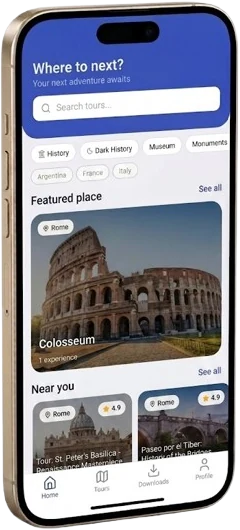
You can walk the basilica on your own in about 45 minutes, but it makes far more sense with the backstory. Trevurs has a free audio tour, Basilica of Luján: The Virgin Who Refused to Move, made by locals, that walks you from the towers to the camarín and across to the museums, so you can play it on your phone instead of waiting for a guided group.
The Youth Pilgrimage: 60 km on Foot
Every October, hundreds of thousands of young people walk from Buenos Aires to Luján. The Peregrinación Juvenil leaves from the San Cayetano sanctuary in Liniers and covers about 60 km, mostly along National Route 7, taking 14 to 18 hours depending on pace. The first one was in 1975 with some 30,000 walkers.
The 2026 edition, the 52nd, was held on October 3 and 4 under the motto "Mother, in your embrace we recognize each other as brothers," just weeks before the papal visit. If you want to try it next year, you don't have to do the full distance: many people start in Moreno (about 32 km left) or General Rodríguez (about 16 km). It is free and requires no registration. Bring broken-in shoes, spare socks, water and a SUBE card for the ride home.
The Complejo Museográfico Enrique Udaondo
Across the plaza from the basilica, the colonial cabildo and the so-called Casa del Virrey house the Enrique Udaondo museum complex, one of the most important history collections in Argentina. Highlights include:
- The Colonial and Historical Museum: inside the old cabildo, where British prisoners were held during the 1806 invasions.
- The Transport Museum: home to La Porteña, the first locomotive to run in Argentina (1857), and the Plus Ultra seaplane that flew from Spain to Buenos Aires in 1926.
- Gaucho and rural collections: saddles, silverwork and ponchos.
Opening days have changed in recent years, so check the museum's social media (@museoudaondopba) before you go. It usually opens from Thursday or Friday through Sunday, from late morning.
How to Get to Luján from Buenos Aires
Two options work well, and both are paid with a SUBE card:
- Sarmiento train: take the Sarmiento line from Once station to Moreno (about one hour), then switch to the diesel service that runs Moreno to Mercedes and stops at Luján. The Moreno to Luján leg runs less frequently, so check the timetable on the Trenes Argentinos app before you leave. Plan for around two hours door to door. Luján station is about a 10-minute walk from the basilica.
- Bus 57: the most direct option, with branches from Plaza Italia (Palermo) and from Once to Luján, no transfers. Expect 1.5 to 2 hours depending on traffic on the Acceso Oeste highway.
- Fares: public transport in the Buenos Aires metro area is adjusted almost every month in 2026, so we won't quote a number that will be wrong next week. The train is the cheapest option; check the current fare in the Trenes Argentinos or Cuándo Subo apps.
- Skip: the new express Sarmiento service (Once to Moreno) only runs Monday, Wednesday and Friday, leaving Once in the evening, so it does not help for a day trip.
Avoid the weekend of the youth pilgrimage and May 8 unless you want the crowds; any weekday is calm.
What to Eat and How Long You Need
Luján has a long tradition of feeding pilgrims. The stalls around the basilica sell choripán and sandwiches, and the riverside along the Luján River has recreos and grills where families spend Sunday afternoons. Bring cash for the stalls; restaurants take cards.
How much time? Half a day covers the basilica and the plaza. A full day lets you add the Udaondo museums, lunch by the river and a walk along the waterfront. If you leave Buenos Aires at 9 a.m., you can be back for dinner.
Pope Leo XIV's Mass in Luján, November 11, 2026
According to the official program, the last day of the Pope's visit to Argentina starts with a visit to a federal prison complex, followed by Mass in front of the Basilica of Luján at 10 a.m., before he flies to Lima.
- Where: the altar will be in Plaza Belgrano, next to the basilica, with the original image of the Virgin. Fenced areas run along Avenida Nuestra Señora de Luján to the Matos roundabout, with large overflow zones out to Route 7.
- Crowds: Mayor Leonardo Boto said the city expects over a million people.
- Holiday: the Province of Buenos Aires declared November 11 a special holiday.
- Access: vehicle traffic may be restricted from Monday, November 9, highway access to the city may be cut and large parking areas are planned outside town. The mayor recommended that people with reduced mobility arrive before noon on Tuesday, November 10.
- Transport: as of mid-October, no special train or bus services have been officially announced. Watch Trenes Argentinos and the Municipality of Luján for updates.
Trip status (updated October 17, 2026): on October 13 the Pope underwent surgery at Rome's Gemelli hospital to remove the lower lobe of his right lung after a lung adenocarcinoma was found. He was discharged on October 17 and returned to the Vatican. The Holy See formally keeps the trip on the calendar, but has said no final decision has been made and that it depends on his recovery. Check official sources before you travel for the Mass.
Whatever happens with the visit, the basilica stays where the Virgin decided to stop, and everything in this guide works on any other day.
Explore Luján with Trevurs
Most visitors walk into the basilica, light a candle and leave without knowing why a clay statue the size of a forearm became the heart of an entire country. Download Trevurs before you board the train and play Basilica of Luján: The Virgin Who Refused to Move on the way: by the time you reach the plaza you will know about the cart, Negro Manuel and Father Salvaire's 45-year building project. If you have an extra morning in the city, the free audio tour of the Catedral Metropolitana of Buenos Aires completes the story, from the cathedral where Jorge Bergoglio was archbishop to the shrine where Argentina goes to pray.